The formula to make a Major scale is the same for every single Major key. The I, IV, and V are the only major chords in a traditional major scale. The remaining chords are minor with the exception of the 7th which is diminished. The scale numbers would look like this I ii iii IV V vi vii I. For example in the key of C the scale would be CDEFGABC. Since triad chords are built by using every other note from the one you begin on - a C Major chord would be CEG.

The 1st note is called the root, after that you count steps away, starting with C - making the 3rd E. G is then 5 steps away from the root making it the 5th. You can keep extending chords making 6th, 7th, 9th, 11th, 13th chords, and sus4 chords. You also need to know that you can raise and lower notes if desired in the chords you're writing. If you see a C7#9 it means you raise the 9th a half step. Here's a chart listing the diatonic chords in Major and the three forms of Minor.

Although the keys of C Major and C minor are used in this chart, these relationships hold true for all major and minor keys. A flat "b" is used to indicate chords built on the third, sixth, and seventh notes of the minor scales when that chord root differs from the major scale. You can also substitute chords outside the diatonic family, sometimes called nondiatonic chords. These chords stand out more in a progression than diatonic chords do, because they include notes not in the scale of the song's key, and can be used to great effect.

Here are a few examples that involve substituting major chords for the ii, iii, and vi—the diatonic minor chords in a major key. I get a feeling that you already understand harmony in a practical sense. There's no magic formula, or if there is, the circle of fifths isn't it. You can see on the piano keyboard if the bass moves by a fifth/fourth, and if you keep making those steps, eventually you'll end up where you started. It's really simple, I don't get what the big deal is.

A Major scale has 7 different notes and then ends back on 1, making a total of 8 notes. The scale degrees are numbered with Roman numerals so that you can use upper and lower case letters. Upper case represents a Major chord, lower case are minor chords, and lower case with a little circle in the upper righthand corner of the Roman numeral is diminished. In western music chords are traditionally built by using every other note beginning on each scale degree - giving you a choice of 7 diatonic chords in a Major scale.

And if you want to know more about chord progressions, read the article series. Besides the natural minor scale, the melodic and harmonic scales can also be used as a fundament for chords progressions. The harmonic minor differs from the natural minor with a raised seventh; the melodic minor differs from the natural minor with raised sixth and seventh. Still, the majority of songs written in minor keys use the natural minor.

This step shows how to identify the notes and the name of a triad chord whose root note is the 7th scale degree of the G natural minor scale. This step shows how to identify the notes and the name of a triad chord whose root note is the 6th scale degree of the G natural minor scale. This step shows how to identify the notes and the name of a triad chord whose root note is the 5th scale degree of the G natural minor scale.

This step shows how to identify the notes and the name of a triad chord whose root note is the 4th scale degree of the G natural minor scale. This step shows how to identify the notes and the name of a triad chord whose root note is the 3rd scale degree of the G natural minor scale. This step shows how to identify the notes and the name of a triad chord whose root note is the 2nd scale degree of the G natural minor scale. This step shows how to identify the notes and the name of a triad chord whose root note is the 1st scale degree of the G natural minor scale. As discussed in Chapter 13, it is possible to build a triad of any quality on any given note. Since there are seven scale degrees, there are seven distinct triads.

Together, these sonorities make up the harmonic palette of the key to which they belong. Time for some more playing, using Heal the World you can learn C major chord , D minor chord , and E minor chord . These are the first three chords of the C major scale. The Skoove app will listen and wait for you so take your time to appreciate the different sounds of the major and minor chords. This is one of the chord trees that will aid in the writing and analysis of music.

You can move down the tree but you may not retrograde until reaching the bottom. There are, of course exceptions including cadencing using the IV to I which is called the Amen cadence because of its use in older church hymns. At the end of a hymn people would sing Amen from the IV to I. A good example of a song that uses an amen cadence is "Let it be" by the Beatles (Amen means let it be!). All chords that have a number immediately after the letter are actually dominate chords with added notes. Dominant chords contain a major triad with a minor 7th.
If they are not dominate they will say something like G Maj7 which has a dreamy feel but in the key of C - G is dominate so its notated G7. A G9, G11,or G13 all can be used as a dominate chord. All dominant chords must contain a seventh, though it is possible to leave out the 5th from extended chords such as 13th chords. The I chord is your musical home but you may go other places during your journey but you usually drive back home using the V to get there. In major keys, chords with the same Roman numeral are made up of the same scale-degrees (using the same solfège syllables), and they have the same quality.

In other words, triads labeled "I" in any major key will be major triads containing do, mi, and sol. Iii triads will be minor triads containing mi, sol, and ti, etc. Chords are often labeled according to their function within a key. One system for doing so uses Roman numerals to designate the scale degree of the chord's root.

Some musicians also use Roman numerals to describe the quality of the chord. Capital Roman numerals (I, II, III, etc.) are used for major triads. Lower-case Roman numerals (i, ii, iii, etc.) are used for minor triads. Lower-case Roman numerals followed by a º sign (iiº, viiº, etc.) are used for diminished triads. Capital Roman numerals followed by a + sign (V+, for example) are used for augmented triads. In general, Roman numerals are generally labeled below the score.
Diatonic chords and notes aren't enough for everything. If they were, you wouldn't have accidentals in music. And you could play all songs without the black keys. Every now and then, the set of intervals around the tonic is modified a little bit, for example to get the G major chord. No, it's not diatonic in C minor, but it sounds nice to get that B - C pitch movement. The B note is soooo close to being home, it makes you want to get back home to C much more than a Bb would.

An even stronger relationship is created when you use the seventh chord built on the V of the major key. The seventh chord built on the V in a major key is a dominant 7th chord. Remember, the dominant 7th chord structure is root, 3, 5, flat 7.

This dominant 7th chord creates a lot of tension due to the dissonant interval between the 3rd and 7th of the chord. For example, on a G7 chord the B and F form the dissonant tritone interval. It is called a "tritone" because the notes are 3 whole-steps apart. In this post you'll learn how to build chords of the minor scale, create your own chord progressions and analyze the chord progressions of famous songs in a minor key.

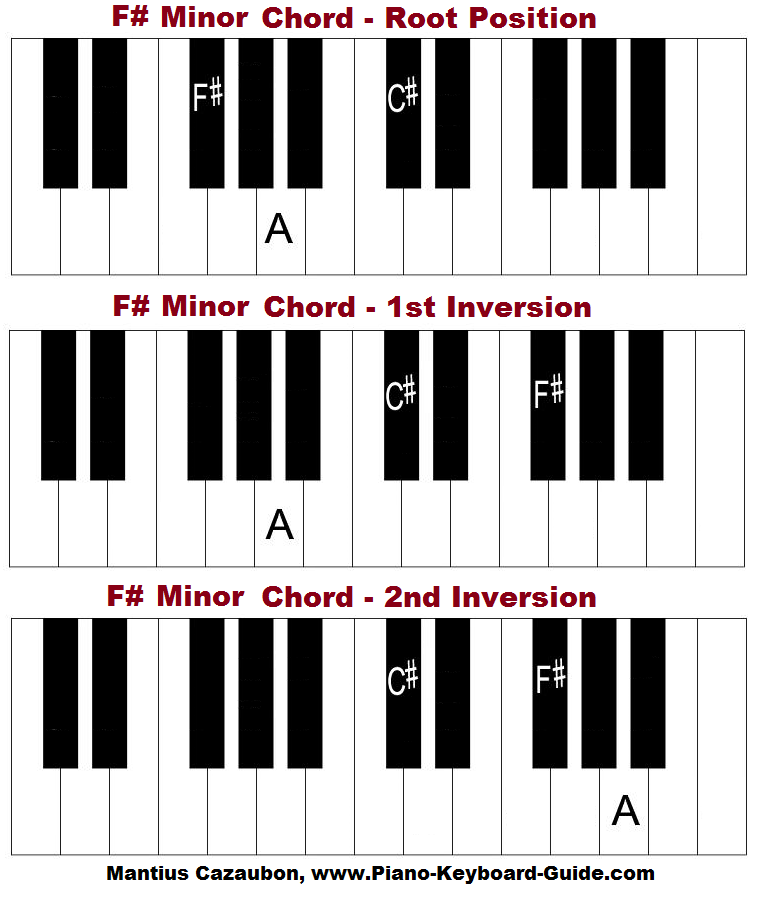
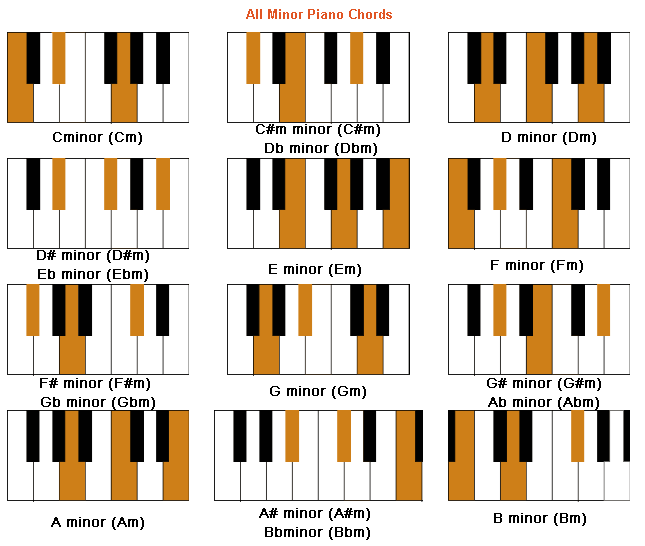
Most of us are familiar with using minor chords in progressions/songs. They are a natural part of the flow of major and minor key music. As we briefly learned previously, we can play major and minor chords in any order as long as the notes remain the same. Inversions are very handy tools that will help add weight, drama, and color to your chord playing. If you already play a chordal instrument, you're likely already able to play the major and minor chords. Heck, if you play the guitar, it's as easy as just making a barre chord shape and moving your left hand around the fretboard.

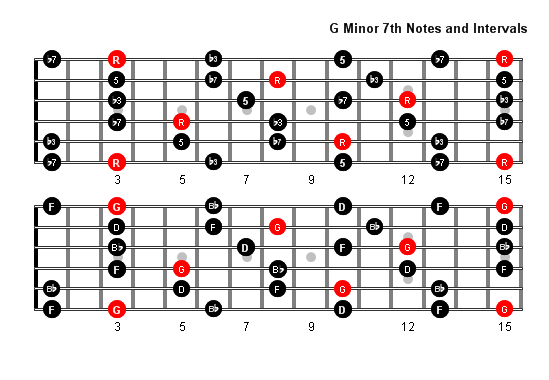
The most common types of triads in Western music are major chords and minor chords. You've surely encountered these if you play a chordal instrument. To construct a major chord, pick a root, then add a major third and perfect fifth above it. This step shows how to identify the notes and the name of a 7th chord whose root note is the 7th scale degree of the G natural minor scale. This step shows how to identify the notes and the name of a 7th chord whose root note is the 6th scale degree of the G natural minor scale.

This step shows how to identify the notes and the name of a 7th chord whose root note is the 5th scale degree of the G natural minor scale. This step shows how to identify the notes and the name of a 7th chord whose root note is the 4th scale degree of the G natural minor scale. This step shows how to identify the notes and the name of a 7th chord whose root note is the 3rd scale degree of the G natural minor scale. This step shows how to identify the notes and the name of a 7th chord whose root note is the 2nd scale degree of the G natural minor scale. This step shows how to identify the notes and the name of a 7th chord whose root note is the 1st scale degree of the G natural minor scale. The chord progression from this website shows that the 1, 4, and 5 degree are to be Cm, Fm, Gm.

But since we are in the harmonic minor scale, the 7th note of the scale , is raised by one semitone, so it is now B natural. This makes the chord progression to be Cm, Fm, G, and now makes it sound better. Like the major scale we can also build 7 chords of the minor scale. In fact the minor scale is relative to the major scale.

When you play the major scale starting on the 6th degree and play seven notes ascending in the scale you are actually playing a minor scale. To find a triad's quality, identify the interval between the root and the other members of the chord. There are four qualities of triads that appear in major and minor scales, each with their own characteristic intervals. It's better to learn how minor key harmony works and not think of it terms of three different minor scales, replacing the dominant chord, etc. Simply put a G major chord is not unrelated or foreign to the key C minor.

But of these seven diatonic triads, one sounds unique. The triad built on the leading tone has a quality that puts it in stark contrast to those built on the other six scale degrees. When it comes to soloing over both forms of the minor blues progression, there are a number of choices available to you.

Your practice sessions, after you've learned your chord shapes and how to play them, are made up of chord progressons. The songs you hear are made up of chord progressions. When you look up the chords to a song, you're looking for that song's chord progressions. The chord progressions should include the notes of the song's melody and harmony as they move along, but they also have to sound good all by themselves.
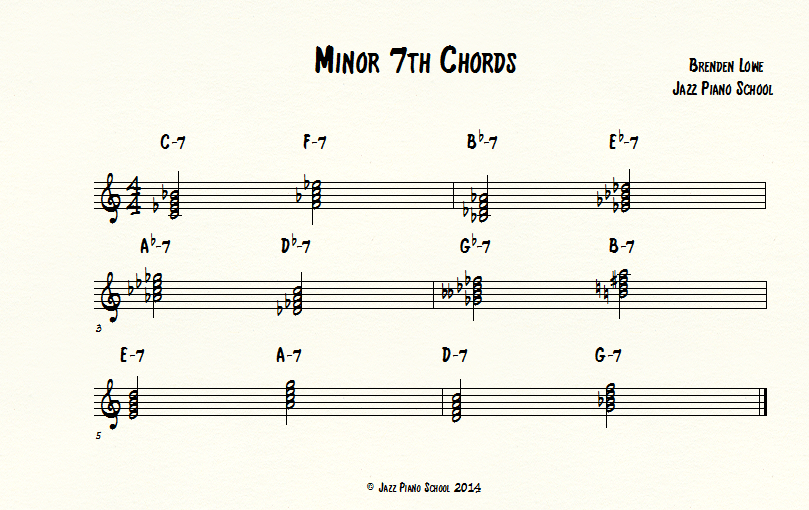
To identify the triad chord note names, use the 1st, 3rd, and 5th columns / scale degrees, which are notes F, A, and C. To identify the triad chord note names, use the 1st, 3rd, and 5th columns / scale degrees, which are notes Eb, G, and Bb. To identify the triad chord note names, use the 1st, 3rd, and 5th columns / scale degrees, which are notes D, F, and A. To identify the triad chord note names, use the 1st, 3rd, and 5th columns / scale degrees, which are notes C, Eb, and G.

To identify the triad chord note names, use the 1st, 3rd, and 5th columns / scale degrees, which are notes Bb, D, and F. To identify the triad chord note names, use the 1st, 3rd, and 5th columns / scale degrees, which are notes A, C, and Eb. To identify the triad chord note names, use the 1st, 3rd, and 5th columns / scale degrees, which are notes G, Bb, and D.
Then there's two others - the harmonic and melodic minor scale sets.Both of which ditch the B♭ note in favour of B♮. That B note is the leading note, just one semitone under the tonic, here, C. That gives a sonic pull towards the C, and is the main reason why G major sounds so good in key C minor. Major and minor chords are the foundation of harmony in Western music. They are the two basic flavors and feelings from which all other chords emerge. The melodic minor is at times used with different notes up versus down the scale, but it can be played with the same notes up and down.
It's created by raising both the 6th and 7th degrees by a half step. The alternative way of coming down the scale is using the natural minor scale down. Here the example uses the same notes up and down the scale.

From the natural minor scale, the harmonic minor scale is created by raising the 7th degree by a half step . That 7th degree becomes a leading-tone instead of a subtonic. It has a rather exotic sound, created by the gap between the 6th and 7th degrees. As its name implies, this scale works especially well for harmonies. The i, iv, and v chords will all be minor 7th chords, and are therefore indicated by lower case roman numerals.
The V chord will be a dominant 7th chord, which is the same type of chord used for all the chords in the major blues progression. The key of the the chord progression will determine exactly which chords will be used. Swapping out a chord or two can really liven up a progression and also help you discover new melodic ideas to sing on top. Here are some simple substitutions you can try in your songwriting. In minor keys, however, there is a frequent harmonic "adjustment" made where the minor v chord of the natural minor scale is changed into a major triad or dominant 7th chord. Minor keys revolve around the natural minor scale.

The v chord, when derived from the notes of the natural minor scale, falls as a minor triad or minor 7th chord. For example, in the key of A Minor the chord built on the fifth of the scale is an Em or Em7 . The notes in these chords all come from the A natural minor scale.


